Whenever I share my German language journal flip-throughs, the same questions pop up: “Can you show us in detail how you set it up? How do you arrange your notes? Why my journal pages are so clean & seem error-free 🤭”, etc.
I’m honored and … overwhelmed at the same time. I’m overwhelmed not because of the number of questions received (I’m suuuper happyyy for that), but because when you finally see that my setup is SO SIMPLE 😅, like under a minute to make.
But that’s the whole point: this has to be quick, easy, and friction-free so we can jump right in with actual language learning & journaling 🥰
So here it is, my complete language learning journal setup, the one I used for 60 days of writing in German. Let’s break it down!
Step 1: Divide the page
Split each page into 2 halves. The left column takes about one third of the page (you’d learn soon what it is for).
Then give one row at the top to the prompt or topic of the entry. For a daily or weekly recount, simply write the day or week number instead.

WANT PROMPTS TO START 👉 How To Start A Language Learning Journal? (60 Journal Prompts A1-B2 Level)
Step 2: Write on the right-hand side
You can draft digitally first (Notes app, Google Docs, Notion, etc.) or on scrap paper if you’re afraid of making lots of corrections in your notebook. I personally use Notion for my first draft.
However, it is of course totally fine to go in with your journal notebooks in the first attempt. What matters at this step is:
✨Don’t be afraid to make mistakes!
Journaling is a safe and private space to express yourself. It is not scored or timed.
It is exactly this reason that I find practicing a new language with journaling (as an introvert) so safe and comfortable.
✨Express your ideas with the vocabulary and structures you already know
Instead of immediately reaching for a dictionary or translator, challenge yourself to describe your thoughts in your own way, using all you have.
This habit will force your brain to work by searching in your memories for already learned (but not used frequently) vocabulary, and even test how well you think you know the language, like have you really got that grammar rule or that verb-preposition combination.
If you are a complete beginner and struggles with the first entry, just start small with 3-5 sentences and stick close to your textbook.
✨Are you a beginner self-studying German right now? Then check out:

Step 3: Ask for feedback
Send your text to your tutor or a German native-speaker friend, and/or paste it into an AI tool like ChatGPT or Claude for proofreading.
🤖 Want the exact prompt I’d use?
Copy-paste it from the box at the end of this post. This prompt lets AI correct your text and show you what a target language version could look like.
Step 4: Rewrite with corrections
After receiving feedback, the final step is to rewrite your entry with the corrections.
This step is often skipped, but it is extremely powerful. When you rewrite the improved version, your brain processes the correct structures again, which helps you remember them better.
✨Writing by hand strengthens memory and helps new vocabulary and grammar stay in your mind longer.
A study by Van der Weel & Van der Meer (2024) of 36 university students found that handwriting produced richer brain connectivity than typing, in patterns linked to memory formation and encoding new information.
So the slow, old-school pen really is doing something for your language learning!
Step 5: Collect new words on the left
I believe this is the part where many of you are interested in: the left column!
I use this column to quickly jot down new words or phrases in red or bright-colored text, so I can spot them quickly when flipping back later.
(Optional tip) Underline or circle the mistakes you made earlier and have now corrected.
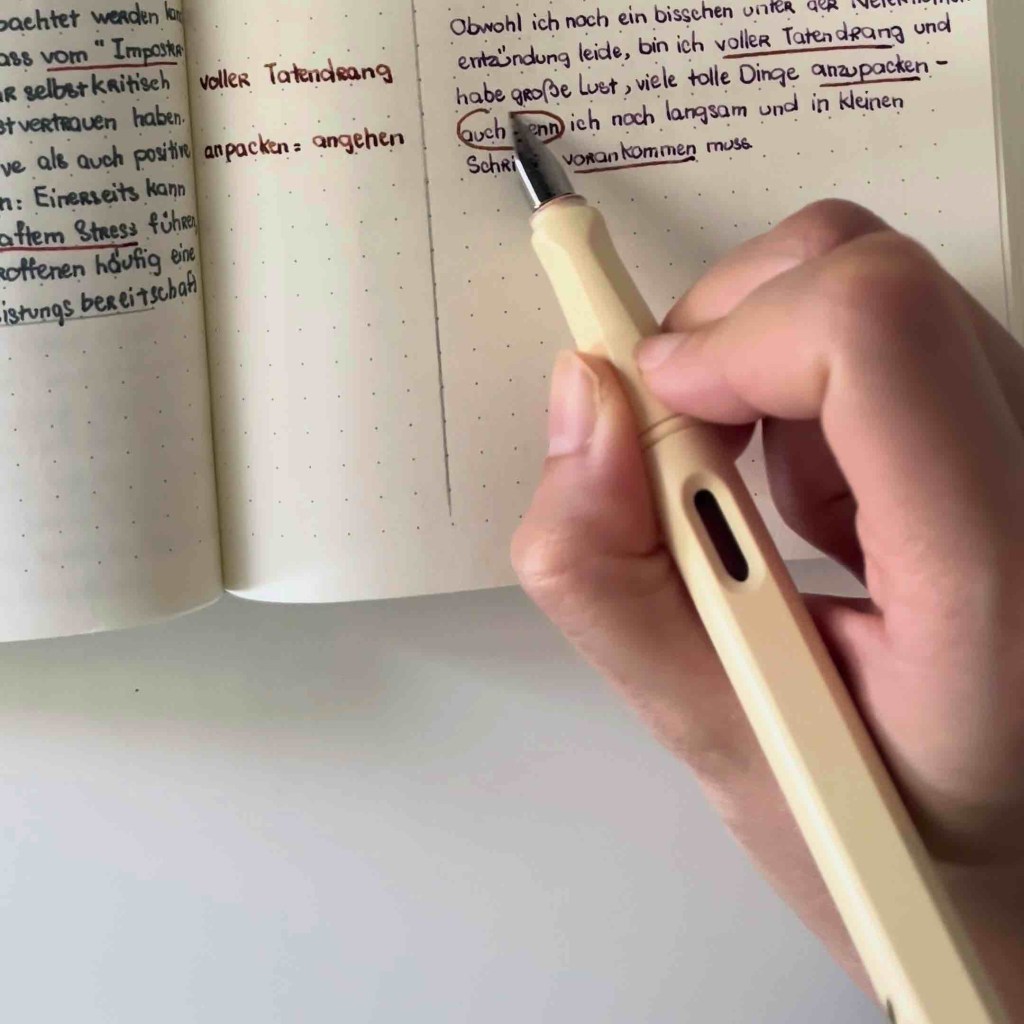
It is as simple as that!
You don’t need a perfect notebook or long essays. Even 3-5 sentences and 10-20 minutes is enough.
Adjust this language learning journal setup to fit your life, increase the difficulty of the prompts or topics you’d like to write about, and keep noticing what works for you, what makes your journal-study language learning fun.
Got any more questions or suggestions? Tell me in the comments!
Warm regards,
Suani 💕
BONUS SECTION: AI PROMPT FOR WRITING IMPROVEMENT
You are a patient, expert [TARGET LANGUAGE] tutor. I am a language learner whose current level is [YOUR LEVEL, e.g. B1] and my goal is [TARGET LEVEL, e.g. C1]. My native language is [YOUR NATIVE LANGUAGE]. Below is my journal entry in [TARGET LANGUAGE]. The topic was: [TOPIC].
Please do the following, in this order:
- CORRECTED VERSION: Fix only my errors (grammar, spelling, word choice, word order, prepositions, cases/articles if relevant). Keep my own ideas, voice and sentence structure wherever they are already correct. Do not rewrite more than necessary.
- MY MISTAKES EXPLAINED: List each mistake as: original → correction → a short explanation in [EXPLANATION LANGUAGE, e.g. English] of the rule behind it. Group mistakes by type (e.g. verb position, articles, vocabulary) and tell me which 1-2 patterns I should focus on next.
- [TARGET LEVEL] ENHANCED VERSION: Rewrite my text as a [TARGET LEVEL] learner would write it, using more precise vocabulary, natural collocations, idiomatic expressions, linking words and more complex sentence structures. Keep the same meaning and a personal journal tone. Highlight the new words and structures in bold.
- VOCAB TO COLLECT: Give me 8-10 of the most useful new words or phrases from the enhanced version, with their [EXPLANATION LANGUAGE] meaning and one short example sentence each, so I can write them in my journal’s vocabulary column.
- Finish with 2 follow-up questions in [TARGET LANGUAGE] about my topic, so I can keep practicing.
Here is my entry:
[PASTE YOUR JOURNAL ENTRY HERE]


